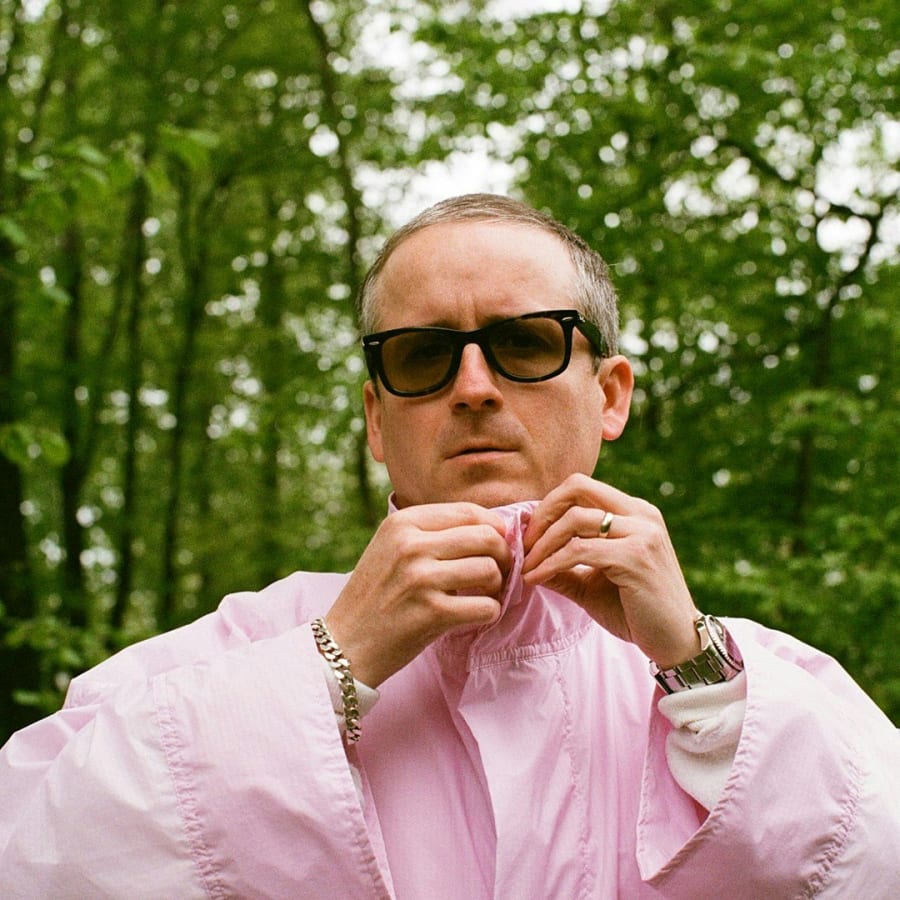
**Alexis Taylor** Alexis Taylor is one of the UK’s most distinctive singer-songwriters. With each release outside of pop giants Hot Chip, he has moved effortlessly between intimate recital music (2016’s Piano), improvised music with About Group, avant-electronica (2018’s Beautiful Thing) and chamber pop (2021’s Silence). He continues to be as relevant as ever, having just celebrated 25 years with Hot Chip. As well as significant milestones, Taylor remains a prolific producer, remixer and collaborator, appearing on key releases this year from HAAi and Superpitcher, remixing Paul Weller and linking up with French touch pioneer Fred Falke & Zen Freeman (Ampersounds). A singular voice, he’s built a substantial body of solo work over the years. But his seventh release, ‘Paris In The Spring’, feels like his magnum opus. It’s Taylor’s most revealing album yet, peeling back the layers of his psyche to reveal sentiments both specific and universal. The subject matter doesn’t shy away from hard-hitting themes but musically, it’s carefree, brightly-lit and contemporary, drawing on leftfield pop, country, elegant disco-house and Vangelis-inspired soundscapes. Testament to his skill as a curator, he’s called on some impressive personnel to help create its effervescent sound world: Air’s Nicolas Godin, The Avalanches, Lola Kirke, Étienne de Crécy, Pierre Rousseau (Paradis), Ewan Pearson, Elizabeth White of Pale Blue and Scritti Politti’s Green Gartside, to name but a few. In this world, the confessional style of country greats is charged by the pop melodicism of Paul McCartney, the futuristic funk of Sly and the Family Stone and, as Taylor puts it, “synthesisers left out in the rain”. It’s where British Americana meets Gallic flair, somewhere on Mars. Is it his cosmic cowboy record? “Well,” he smiles, “the working title was Cocaine, Wild Horses and Real Love.” Thankfully, no synths were actually harmed in the making of the album. The bulk of it was done at Godin’s studio in Paris, which Godin invited him to use after the pair collaborated on his 2020 solo material. This “creative cocoon” was a gear heads’ dream, with every bit of kit that Taylor loved using, “from a grand piano, vibraphone and clavinet to old drum machines, a Fender Rhodes and a Mellotron,” imbuing his music with a warm and grainy analogue glow. He could work there at his own rate, without any pressure, and had the freedom to experiment. Godin’s son Pablo, who’d trained under Nigel Godrich, took up the role of engineer, while Godin Senior stepped in on vocoder and bass guitar on ‘mp3s Can Make You Cry’ – effectively a robo-duet between the two vocalists. “I was really interested in vocoders,” says Taylor, “and Nicolas said, ‘Well, I’ve got all of them!’ so I had this incredible tutor in terms of how to get the best sounds.” The track title tells a story but ultimately the song, and the album, is about Taylor backing himself as a songwriter. “I might get caught up temporarily in thoughts about high fidelity versus low fidelity, but none of that really matters when the writing is moving and can connect with people,” he says. “So I’m trying to stand up for my own place in the world as a music-maker.” The French musician and producer Pierre Rousseau began dropping by these Paris sessions from his neighbouring studio and ended up working on half of the tracks. Taylor calls him “one of the best producers I’ve ever worked with”, noting album opener ‘Your Only Life’ as emblematic of his creativity. He morphed the violin that Taylor had recorded at home with Emma Smith (Pulp, Beth Gibbons) into “Robert Fripp-like guitar sounding oddities” while Taylor’s marimba parts were whirled into coruscating loops. “Or he’d change the order of the notes, the pitch or the timbre of the sound. These transformations were really exciting – they created subtle and ever-shifting earworms, working at some kind of subconscious level.” It’s a theme that weaves itself mysteriously throughout ‘Paris In The Spring’. The title itself references a psychological test where things are not as they seem and though Taylor is happy to explain his lyrics to some degree, he adds that “you have to look for those double meanings, or what’s hiding under the surface.” There are songs about battling demons and losing friends (‘Black Lodge in the Sky’, named for the late Mancunian producer), pain and shame (‘On A Whim’ with Green Gartside) and repeating mistakes (‘For A Toy’). The latter track is a Harry Nilsson-channeling piano ballad but its bombast is undercut by frustration, sharing a lyrical thread with Neil Young (“why do I keep fucking up?”). And yet, at the same time, these songs sound as bright and comforting as classic pop songs, warm crescendos of joy beaming into space. Another standout, ‘I Can Feel Your Love’ is “a gospel record hiding in plain sight”. A collaboration with Australian sampledelic group The Avalanches, “it feels like it could be about something heavenly and sublime, or is it about a person’s deep admiration for another?” Taylor wonders. The Avalanches sent him the instrumental and the track was finished off in Paris with French producer Étienne de Crécy. “It had this disco vibe that was really uplifting,” says Taylor. “I was truly inspired by it and the words came quickly. It’s a positive-sounding song, I think.” At the other end of the emotional range, ‘Colombia’ is one of Taylor’s starkest moments, sticky with despondency and alienation. “It was a breakthrough for me in terms of being powerful and vulnerable at the same time; it’s very revealing,” he says. It’s a lonely, heartbreaking song – not a heartbreak song, he hastens to add. He’d imagined it as a sibling to ‘To Be Of Use’ by Smog or echoing the same sentiment and sound design as the Willie Nelson line “we’re not lonesome, my cricket and me”. Taylor thinks about the song evocatively: “It’s a country duet without a partner, the throb of the rhythm box the only company for a singer and his instrument.” But there’s humour here too, which cuts through his “sad eyed funk”. When he sings about “all the MDMA in Manchester – those are meant to be quite amusing lyrics,” he adds. He’s not lonesome forever, though. The duet finally arrives with ‘Out of Phase’, starring Nashville’s Lola Kirke. “She’s the modern-day country singer. Her voice is so strong and she’s also really playful,” says Taylor. While there isn’t a pedal steel guitar in sight – the track is more of a spacey NYC garage epic – Taylor says he had in mind that Peter Gabriel originally approached Dolly Parton to duet with him on ‘Don’t Give Up’, before Kate Bush. Similarly, he wanted a rootsy voice to elevate the track to another place – singing, as they do, about the “lost highways of history”. David Lynch passed away as he was writing it. “It’s about getting away from yourself and being transported somewhere else by your imagination, or by films that take you off to another place, and trying to understand your place in the world in relation to why you have these deep obsessions.” Joining all the dots is Taylor’s cover of Rolling Stones’ classic ‘Wild Horses’ – as clear a signifier as any of the album’s ambition. “I love Gram Parsons’ delivery of that song in the Flying Burrito Brothers’ version,” he says. Except that, this being Taylor, his take is inspired by the 80s reggae-electro of ‘It Takes A Muscle (To Fall In Love)’ by Dutch new wave band Spectral Display and the dub-techno releases of Rhythm & Sound. It’s testament to Taylor’s inventiveness: “I like covering famous songs and then turning them on their head,” he says. “I need to inhabit a song and make it new. I cannot shake certain songs and their impact on me.” It was a fun record to start and a difficult one to finish. Collaborators disappeared. Songs were left incomplete. Taylor finished the album back in London with producer Oli Bayston and mix engineer, the Balearic don Ewan Pearson. Tellingly, ‘Your Only Life’ references a period where Taylor felt depressed and unmotivated, its resonant opening line – “I don’t know if I’m in a rainbow of gloom / or if I’m just lazy” – noting the universal tendency to wallow. The song asks: “Am I not able to complete my master work because I am struggling? Or do I need to get out of bed and get on with it?” And it arrives at the conclusion that “you’ve only got the one”. Ultimately, this is an album about freedom. From constraints, from preconceptions, from genre. Taylor has always been an open book in terms of his influences but one can’t help but think of Arthur Russell, sequestered away in a studio among his collaborators, recording during all-night sessions under the full moon, creatively and unanimously autonomous. Like Russell, Taylor experiments with all different musical styles – country, folk, disco – and has weaved it together here into something unique. “Sometimes an audience wants to be told, what is this?” says Taylor. “And I’m refusing to do that. You can find great things in music when you open up to real listening. No one needs to be told “what something is”, otherwise why would we be making something so straightforward? Be ready to be surprised, to find something new in music, and let the music resonate with you.”

Sun, Apr 5 · Zebulon

Sun, Apr 5 · Zebulon

Mon, Apr 6 · Zebulon

Tue, Apr 7 · Zebulon

Wed, Apr 8 · Zebulon

Thu, Apr 9 · Zebulon